CRMs that integrate with Make.com
CRMs with mature Make.com (formerly Integromat) integration — visual workflow automation that fires on CRM events, multi-step scenarios across 100+ apps, and the kind of mid-market automation depth Zapier doesn't always reach.
Why Make.com-native CRM integration matters
Make.com (formerly Integromat) is the workflow automation layer most often picked when Zapier's per-task pricing or single-step model becomes a constraint. Make's strength is multi-step scenarios — a single workflow can branch on data, iterate over arrays, call multiple APIs, transform fields, and write to several systems with full visibility into the data flow. For mid-market ops teams, that depth is the difference between automation that scales with the business and automation that quietly breaks every Tuesday. The CRMs below ship native Make.com integrations that expose triggers (new contact, deal stage changed, custom object updated) and actions (create record, update field, add note) directly — no webhook gymnastics, no custom HTTP modules.
The depth difference between a real Make integration and a fake one is mostly visible in two places: trigger granularity (whether the CRM emits events at the level of individual field changes, custom objects, or only contact/deal create) and the action surface (whether you can update arbitrary fields and custom objects, or only the canonical contact/company/deal entities).
What to prioritize
- Native triggers for CRM events. New contact, deal stage changed, custom object updated, task completed — all surfaced as Make triggers without webhook setup.
- Field-level and custom-object actions. Make scenarios should be able to update any field on any object, including custom objects you've defined in the CRM.
- Bidirectional data sync. Pull from external APIs into the CRM; push from the CRM out to data warehouses, data clouds, billing systems, and ops tools.
- Error handling and retry. Mid-market ops cares deeply about scenarios that fail gracefully — partial retries, error notification routing, and replayability matter.
- Cost predictability. Make's operations-based pricing is unusually CRM-volume-friendly compared to Zapier's task-based model — particularly for high-volume CRM events.
When Make.com is the right call
- Mid-market ops teams running 50+ active automations across CRM, billing, support, and data pipelines — Make's multi-step scenarios and operations pricing scale better than Zapier at this volume.
- Companies hitting Zapier's pricing wall at the per-task tier — Make's same-volume cost is often 30–50% lower for CRM-heavy automation.
- Ops teams that prefer visual workflow builders over code — Make's flow visualization is more legible than n8n for non-engineers, and more powerful than Zapier for non-trivial logic.
When Zapier or n8n might fit better
Zapier wins on app catalog breadth (7,000+ apps vs Make's ~2,000) and ease for single-step automations — pick Zapier if your scenarios are mostly "when X happens, do Y." n8n wins on developer ergonomics and self-hosting — pick n8n if your team is engineering-led, code-friendly, or has data-residency requirements that rule out cloud automation. Make sits between the two: more powerful than Zapier, more accessible than n8n, and unusually well-priced for CRM-heavy operations.
Below: CRMs with Make.com integration in our directory

lemlist
Sales EngagementOutbound tool for sales teams: a 650M+ lead database plus sequences across email, LinkedIn, calls, WhatsApp and SMS, with built-in email warm-up.

SmartSuite
CRMNo-code work platform where teams build CRM, project, IT and GRC apps from templates. Team plan from $15/seat/mo (annual, 3-seat minimum).

FreeScout
Help DeskOpen-source help desk and shared inbox built on PHP and Laravel that you host yourself, with unlimited agents, tickets and mailboxes and 50+ paid or free modules.

NetHunt CRM
CRMNetHunt CRM runs inside Gmail and Google Workspace, with lead and deal pipelines, email campaigns, WhatsApp and messenger channels, sales automation and an MCP server.
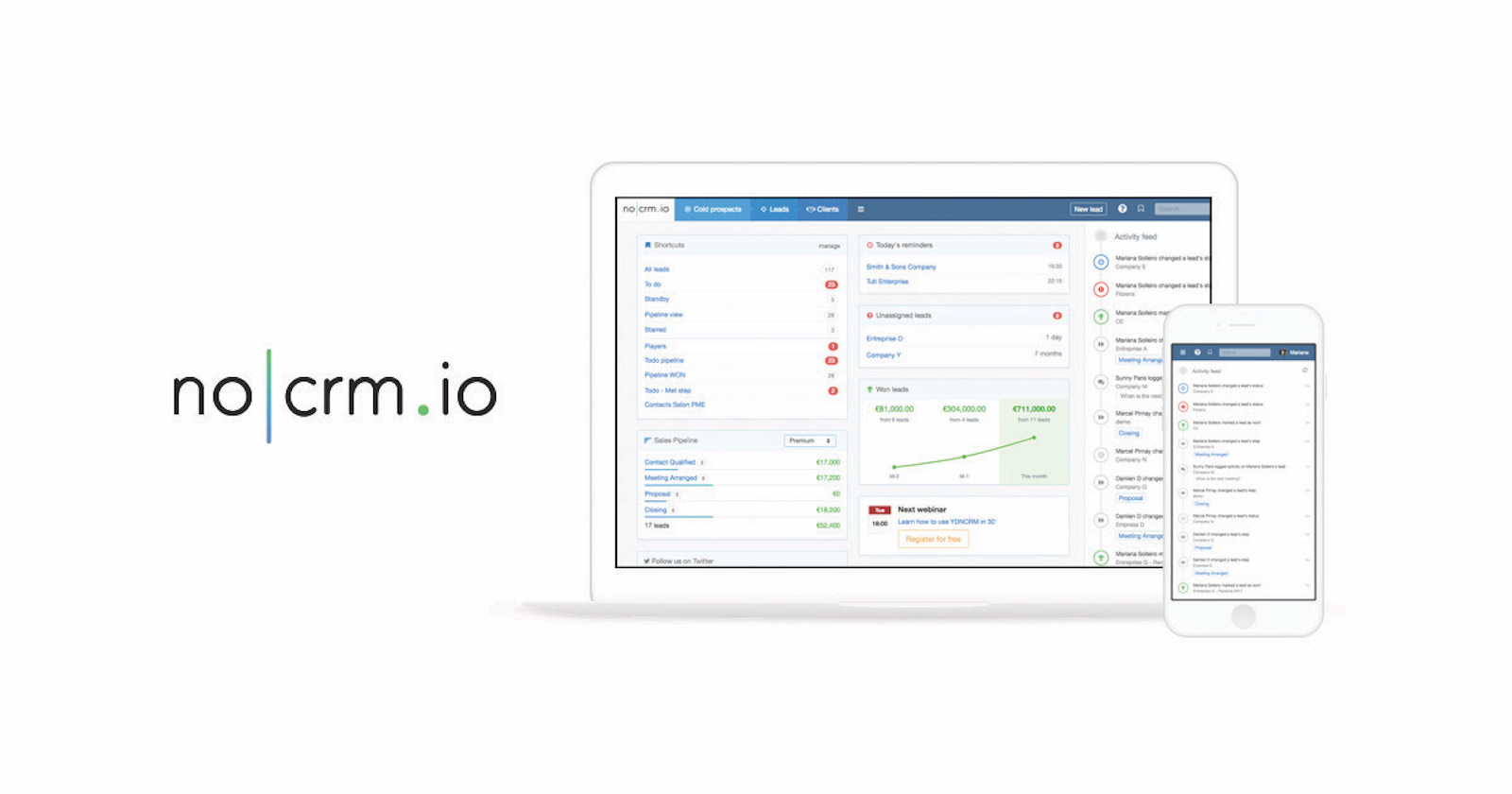
noCRM.io
CRMnoCRM (now Positive noCRM, from Positive Group) is a lead-management CRM built around next actions, with quick lead capture, a mobile app, quotes and invoices, and 3,000+ integrations on higher plans.

Pipedrive
CRMSales CRM built around a Kanban-style pipeline, with workflow automation, email and calendar sync, and a marketplace of 500+ integrations. Aimed at small sales teams.

Salesforce Sales Cloud
CRMSalesforce Sales Cloud is a CRM for lead, opportunity and forecast management, with Agentforce AI sales agents. Editions range from a free suite to $550 per user per month.

Salesmate
CRMCRM with pipeline management, marketing automation, ticketing and AI agents in one platform. Serves 8,500+ businesses and lists 700+ integrations.

Sellsy
CRMFrench CRM, quoting and invoicing platform for freelancers, SMEs and mid-market firms, with marketing campaigns and cash-flow forecasting. Part of the TeamSystem group.

Zoho CRM
CRMCloud sales CRM with lead and deal tracking, multiple pipelines, workflow automation and Zia AI. Free for up to 3 users; paid plans from $14 per user a month.

Close
CRMSales CRM for outbound teams with a built-in dialer, SMS, email and an AI agent called Chloe. Plans run $9 to $139 per user per month; the site lists 11,500+ teams.
Folk CRM
CRMContact-based CRM with a free two-week trial, LinkedIn and email capture, AI assistants and lead scoring. Used for sales, partnerships, recruiting and fundraising.

Monday CRM
CRMmonday CRM is a board-based CRM from monday.com with pipelines, a communications hub, quotes and invoices, automations and AI agents for lead sourcing, outreach calls and meeting prep.
HubSpot CRM
CRMHubSpot is a CRM platform with Sales, Marketing, Service, Content and Data hubs on one contact database. It fits SMB and mid-market teams that want a free CRM to start and paid hubs later.