Who should leave NinjaOne
NinjaOne is one of the strongest unified RMM platforms you can buy — patch automation, real-time monitoring, remote access, and backup in one console, rated a G2 Grid leader for more than 23 straight quarters. But its design choices define its edges. Pricing is per-device and quote-based, typically $2–3.75/device/month, which scales cleanly for large fleets but turns expensive for MSPs managing many endpoints per technician — and it means a sales call before you see a real number. NinjaOne is also pure IT operations: there is no PSA, no ticketing-and-billing layer, and no customer relationship side. If you run a managed service business, you still need to bolt on a separate PSA.
You should leave if per-device math is working against you, if you want PSA and RMM under one subscription instead of two vendors, or if your actual need is internal service-desk ticketing or asset discovery rather than full endpoint management. Teams that should stay are MSPs and IT departments managing large, distributed fleets who value NinjaOne's automation depth and maturity and don't mind the per-device model. If the monitoring and patching are doing their job, switching buys you little.
What to consider
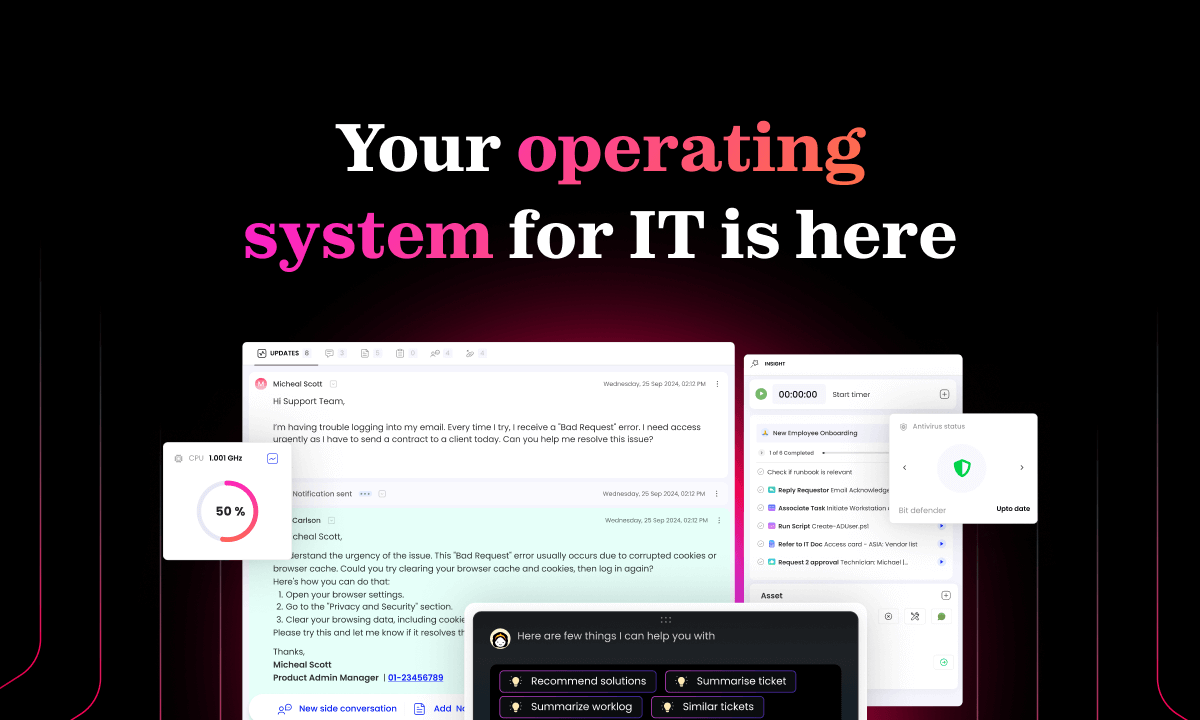
- Best for a modern unified PSA + RMM → SuperOps. Where NinjaOne is RMM-only, SuperOps folds ticketing, projects, billing, and monitoring into one purpose-built platform with AI alerting that filters noise. Per-technician pricing (each license includes 150 endpoints) runs $89/tech/mo for PSA, $149/tech/mo with RMM — predictable as your device count climbs.
- Best for flat per-tech pricing → Syncro. The clearest answer to NinjaOne's per-device model: one flat rate of $129/user/mo (annual) with unlimited devices, plus built-in PSA, help desk, and M365 management. If you manage many endpoints per head, this is where the cost curve bends in your favor.
- Best for internal IT service desk → Freshservice. If you don't actually need RMM but proper ITSM — incident management, an auto-updating CMDB, and employee self-service — Freshservice delivers it with Freddy AI from $19/agent/mo (Growth $49, Pro $99). The move for internal IT teams drowning in email tickets, not endpoint alerts.
- Best for enterprise, cross-department service → Halo Service Solutions. HaloITSM, HaloPSA, and HaloCRM share one data model with codeless, ITIL-aligned automation spanning IT, HR, facilities, and customer support. Pricing is contact-vendor only and implementation is heavier, but for complex enterprise service operations it replaces several contracts at once.
- Best for asset discovery and compliance → Lansweeper. If the real gap is visibility — a live, accurate map of every device, license, and vulnerability — Lansweeper's agentless discovery sweeps on-prem, cloud, and hybrid estates and feeds ServiceNow, Jira, and Microsoft. A free tier covers small environments; larger deployments are quote-based.
- Best for zero budget → Spiceworks. Free and ad-supported, installed on a Windows box, it auto-discovers LAN devices, monitors uptime, and runs a help desk tied to assets. The UI is dated and it won't scale past a single small site, but for a solo admin with no budget it still works.
Match the alternative to the gap
The mistake is shopping for "a cheaper NinjaOne." NinjaOne's RMM is excellent — the reason to leave is almost always a capability it doesn't cover or a pricing model that fights your shape. Name the gap first.
Tired of running RMM and a separate PSA? SuperOps and Syncro put both under one bill, and Syncro's unlimited-device pricing directly counters the per-device squeeze. Realize you don't need endpoint management at all, just structured ticketing? Freshservice fits internal IT; Halo fits sprawling, multi-department enterprises. Just need to know what's on the network? Lansweeper for serious discovery and compliance, Spiceworks when the budget is zero.
Trial advice
Because NinjaOne is genuinely capable, a replacement has to clearly win on the one thing that drove you out — usually pricing model or missing PSA/ITSM — not merely match it overall. Most of these run real free trials (14 days for SuperOps and Freshservice; Spiceworks and Lansweeper have free tiers) so model your true all-in cost at your actual device-to-technician ratio, not the headline rate. Pilot your top two with a live week of tickets and patching before your NinjaOne renewal lands.