Relate vs Attio (2026)
Two modern, spreadsheet-fast CRMs with generous free tiers and very different pricing traps. Relate caps how long it remembers your correspondence; Attio caps how many people can sit on its cheap plan. Both meter enrichment on top of seats.
Relate
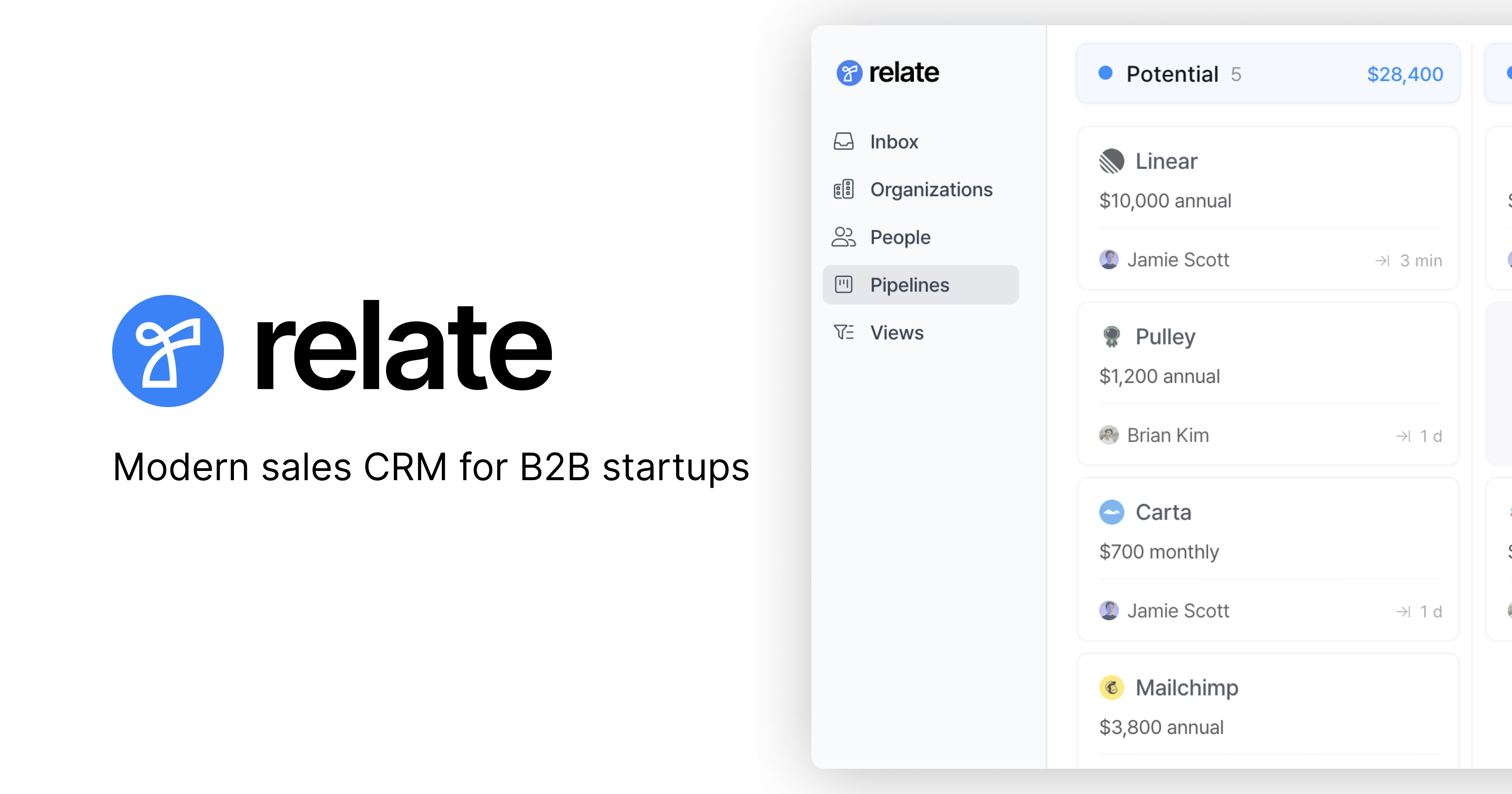
Sales CRM for B2B companies, backed by Y Combinator, with deal pipelines, a shared inbox, LinkedIn integration and enrichment. Free personal and team plans.

TL;DR
- Relate is free with unlimited contacts, LinkedIn sync, and 250 enrichments, but every free plan forgets email and note history after 30 days. Personal Pro is $15/month; Team Business is $60/user/month.
- Attio is free for up to 3 users with 100 seat credits each and 250 workspace credits monthly. Plus is $35/user (capped at 10 users), Pro is $79, Enterprise is quoted.
- Neither bill is purely per-seat. Attio spends credits on enrichment and AI actions; Relate gives every plan a flat 250 enrichments and charges pay-as-you-go beyond that.
The free plans give away opposite things
Relate hands you unlimited contacts on the free tier — not 500, not 1,000 — plus LinkedIn integration, import/export, and 250 enrichments. Then it caps history at 30 days. For a relationship CRM that is the load-bearing constraint: you can hold a hundred thousand names and still be unable to recall what you told any of them last quarter. Personal Pro at $15 exists almost entirely to remove that cap. You are buying permanence, not features.
Attio's free plan caps people instead: three users, with real-time contact syncing and automatic enrichment intact and no expiry. It is a plan you can sit on while deciding rather than a countdown. Its honest limit is 250 workspace credits a month — enough to see what enrichment does, not to depend on it.
So the free-tier question is straightforward. If you are one person keeping a large network warm, Relate's free plan is more generous until you need memory. If you are a founding team of three that wants shared, permanent records, Attio's is the better zero-dollar starting point.
Two cliffs, at different places
Relate's cliff is individual-to-team. Personal Pro is $15; Team Business is $60 per user, four times the price, with nothing between. A three-person firm that just wants shared contacts and history that does not evaporate must either run three separate Personal Pro accounts at $45 and lose shared visibility, or pay $180 a month for Business and receive pipeline reporting it may not want. Reporting and dashboards live only on Business, so there is no cheaper route to team visibility.
Attio's cliff is headcount. Plus is capped at ten users, so the eleventh person moves the whole workspace to Pro — $350 a month becomes $869, a 148% jump for one hire. If you sit at eight or nine and are recruiting, price Pro now rather than being surprised by it.
Both cliffs are avoidable if you see them coming. Neither is obvious from the pricing page.
Enrichment is the second meter on both
Attio grants seat credits and workspace credits monthly: 100 and 250 on Free, 500 and 1,500 on Plus, 1,000 and 10,000 on Pro. Top-up blocks run from $70/month for +5,000 up to $475 for +50,000 on annual billing. Note the workspace pool grows 6.7x between Plus and Pro, because Attio expects Pro customers to automate across the entire database rather than enrich what individual reps touch.
Relate's version is blunter and, at team scale, harsher. Every plan gets 250 enrichments — free, Personal Pro, and Team Business alike. The allowance does not rise with price. A ten-person Business team paying $600 a month receives the same quota as somebody on the free plan, which makes overage billing near-certain rather than a risk. Get the per-enrichment rate in writing before you commit.
Data model versus deal momentum
Attio's distinguishing feature is malleability. You define your own objects, fields, views, filters, and templates without a developer, and multiple people can edit a record simultaneously the way they would a shared doc. That is why it attracts VC firms, recruiters, and ops-led teams who reject someone else's contact-and-deal schema. The trade-off, per the repo's own caveat, is that deep customization takes trial and error, and forecasting and full sales analytics remain limited.
Relate is deliberately narrower. Its Cycles feature drives structured follow-up so a small team keeps deal momentum without a dedicated SDR, and the UI is built for spreadsheet-speed navigation with most actions reachable without menu diving. Advanced reporting, forecasting, and deep automation are explicitly not the point. It is also a younger product — integrations and API maturity trail established CRMs.
Guests, warehouses, and where each is headed
Relate meters guest invites separately: 10 on free plans, 50 on paid, 100 on Enterprise. For a venture firm or advisory business routinely sharing network access with portfolio companies or partners, that ceiling arrives independently of seat count. Its Enterprise tier lists data warehouse integration, reverse ETL, and multi-workspaces, which says plainly who Relate is chasing — firms where the network is the asset and needs to be pushed back into their own systems.
Attio's Enterprise adds 2,500 seat credits per user, negotiated workspace credits, and enterprise security, and is annual-only. Below that, Attio sells single seats with no minimum, so a solo operator pays $35 and nothing phantom.
Who should pick what
- Solo investors, founders, and advisors keeping a network warm → Relate free, upgrading to Personal Pro at $15 the moment 30-day memory bites.
- Founding teams of two or three wanting shared permanent records → Attio free, then Plus.
- Teams of four to ten that want shared records and pipelines → Attio Plus at $35; modelling your own custom objects needs Pro at $79.
- Small sales teams that want structured follow-up cycles over reporting depth → Relate Team Business, budgeting enrichment overage separately.
- Anyone enriching heavily at team scale → Attio, whose credit allowance at least scales with the tier.
- Teams sitting at eleven-plus users → Attio Pro is forced; price it before you hire.
Bottom line
Attio is the more capable platform and the more predictable purchase: a real free tier, single-seat pricing, and a data model you can bend to your workflow, with the ten-user cliff and credit burn as the two things to model in advance. Relate is sharper for one specific person — the individual whose network is their business, where free-with-unlimited-contacts is genuinely useful and $15 for permanent history is an easy yes. Where Relate struggles is the middle: a small team that wants shared memory without pipeline machinery has no tier to buy, and the flat 250-enrichment allowance turns a per-seat bill into a usage bill nobody quoted.
Try them yourself
Try Attio: weekcrm.com/go/attio · 10% discount on any plan (affiliate link)
Need help moving to Relate or Attio?
Craftt, the CRM team behind weekcrm, plans and runs the migration: field mapping, deduplication, history and a cutover your team won't notice. You get a fixed quote within one business day.