Relate vs Salesflare (2026)
Salesflare fills its own records from your mailbox and charges $29 to $99 a seat with no free plan. Relate gives away unlimited contacts but forgets your correspondence after 30 days unless you pay. Both are lean B2B CRMs; only one of them is really built for a sales team.
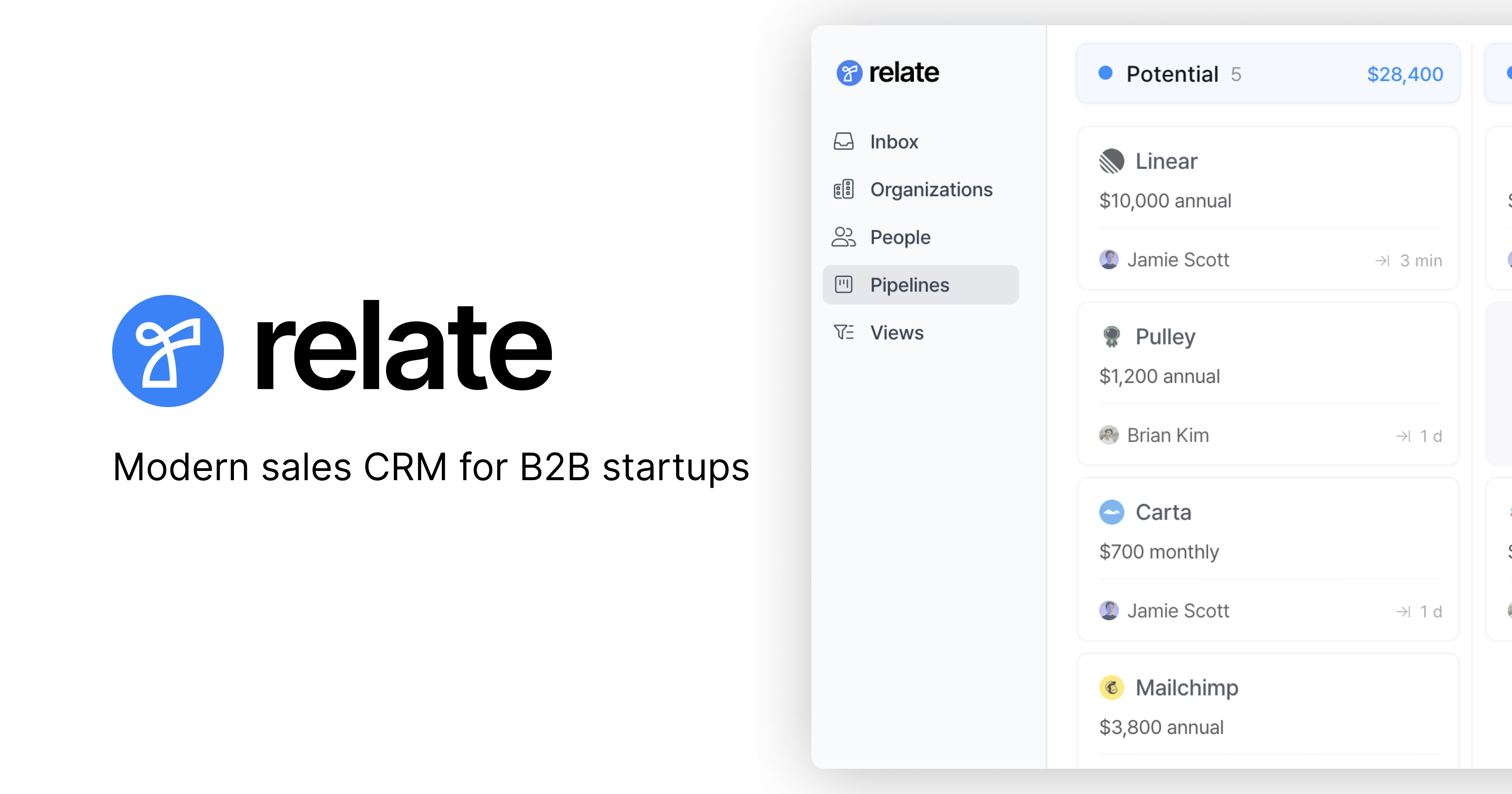
Relate
Sales CRM for B2B companies, backed by Y Combinator, with deal pipelines, a shared inbox, LinkedIn integration and enrichment. Free personal and team plans.

Salesflare
CRM for B2B sales teams that fills contact and activity data from email, calendar and web signatures. Includes pipelines, email sequences and a lead finder.
TL;DR
- Salesflare automatically captures contacts, companies, meetings, emails, and attachments from Gmail or Outlook. Growth $29/user/month annually, Pro $49, Enterprise $99 with a five-seat minimum. No free plan, 30-day trial.
- Relate is free with unlimited contacts and LinkedIn sync, but every free plan drops email and note history after 30 days. Personal Pro $15/month, Team Business $60/user/month.
- At the tiers real teams buy, Salesflare Pro at $49 undercuts Relate Team Business at $60 and brings more sales tooling with it.
What each one automates
Salesflare's whole argument is that reps will not type. It pulls people, companies, meeting records, threads, and file attachments out of the mailbox and populates records without anyone logging anything, so the CRM stays current on its own. On top of that sit email sequences, a built-in Lead Finder, and relationship intelligence that scores how connected your team is to an account and flags ties going cold.
Relate automates less and asks for less. It syncs Gmail and Outlook two ways so correspondence lands in the record without manual logging, adds LinkedIn integration, and uses Cycles — structured follow-up sequences — to keep deals moving in a team with no dedicated SDR. The interface is built for spreadsheet-speed navigation rather than depth.
The prerequisite worth checking first: Salesflare's capture only works against Gmail and Outlook mailboxes. On any other mail system you lose the feature that justifies the price. Relate syncs the same two, so neither serves an unusual mail stack well.
Free tiers, trials, and what evaporates
Relate has a free plan and Salesflare does not. That sounds decisive until you read Relate's cap. Contacts are unlimited on free — genuinely unlimited, with LinkedIn sync and 250 enrichments — but email and note history rolls off after 30 days. For a CRM whose job is remembering what was said, that keeps the name and discards the conversation. Personal Pro at $15 exists to remove the cap; you are paying for permanence rather than capability.
Salesflare answers with a 30-day trial, no card, which is unusually long and enough to run a real team on real deals before committing. It cancels immediately with no notice period, so the annual term is the only commitment you make.
The tiers that matter, side by side
For a team of five with shared visibility and reporting, Relate's only option is Team Business at $60 a seat — $300/month. There is no intermediate team tier; reporting and dashboards live on Business alone, and the step from Personal Pro's $15 to $60 is one of the steepest individual-to-team jumps in this market.
Five seats on Salesflare Pro is $245/month annually, and Pro is where most working deployments land: workflows, user permissions, custom dashboards, and 100 lead credits against Growth's five. Growth at $29 is real for a small team, but five lead credits is a demonstration allowance, and role-based permissions become necessary above roughly four people.
Salesflare's own cliff is Enterprise. At $99 the software matches Pro — what you buy is full onboarding, custom training, a dedicated account manager, and 250 lead credits — and the five-seat minimum puts its floor at $495/month. That is worth it for a messy migration off an incumbent CRM and not worth it for more credits.
Metered extras on both bills
Neither product is purely per-seat, and both meters behave badly at team scale in different ways.
Relate includes 250 enrichments per plan at every tier — free, Personal Pro, and Team Business alike. The allowance does not rise with the price. A ten-person Business team paying $600 a month gets the same quota as a free individual, with pay-as-you-go beyond, which makes overage a certainty rather than a risk. Get the per-enrichment rate in writing.
Salesflare's lead credits at least scale with tier: 5 on Growth, 100 on Pro, 250 on Enterprise. It is still an allowance rather than a flat rate, and it is the most common reason teams move up a tier.
Relate also meters guest invites — 10 free, 50 paid, 100 Enterprise — which constrains venture firms and advisory businesses that routinely share access outside the payroll.
Billing terms
Salesflare discounts annual billing steeply: $10 a seat on Growth, $15 on Pro, $25 on Enterprise, or 25 to 34% off monthly. Ten seats on Pro is $5,880 annually versus $7,680 monthly, a $1,800 difference large enough to change the decision. Growth and Pro have no seat minimum; a solo founder can run Salesflare at $29.
Relate's yearly discount is 15%, modest by category standards — about $540 a year on five Business seats. It should not drive the decision either way.
Maturity and ambition
Salesflare is the more finished sales product but deliberately bounded: built for B2B pipelines, not post-sale or customer-success workflows, with reporting that is solid rather than deep and forecasting that needs workarounds.
Relate is younger, and the repo is candid about it — integrations and API maturity are still developing, and advanced reporting, forecasting, and deep automation are not the focus. Its Enterprise tier lists data warehouse integration, reverse ETL, and multi-workspaces, which reveals the real target: firms where the network is the asset and needs pushing back into their own systems.
Who should pick what
- B2B sales teams whose last CRM died of neglect → Salesflare, on Gmail or Outlook.
- Solo investors, founders, and advisors keeping a network warm → Relate free, then Personal Pro at $15.
- Teams doing genuine outbound prospecting → Salesflare Pro, for the 100 lead credits and workflows.
- Small groups wanting shared history without pipeline reporting → neither fits cleanly; Relate has no tier for you and Salesflare has no free plan.
- Anyone migrating messy data off an incumbent CRM → Salesflare Enterprise, if you can clear five seats.
- Network-driven firms planning to pipe relationship data into a warehouse → Relate Enterprise.
Bottom line
For a sales team, Salesflare is the stronger and cheaper choice: $49 Pro beats $60 Business, the automatic capture solves adoption directly, and the 30-day trial lets you prove it on live deals. Relate earns its place with individuals — the free plan is unusually generous for one person, and $15 for permanent history is an easy call. The gap in Relate's lineup is the small collaborative team, which either overpays for sales machinery it did not want or works around the 30-day memory. Before either purchase, price the metered line: enrichments on Relate, lead credits on Salesflare.
Try them yourself
Need help moving to Relate or Salesflare?
Craftt, the CRM team behind weekcrm, plans and runs the migration: field mapping, deduplication, history and a cutover your team won't notice. You get a fixed quote within one business day.