SherpaDesk vs SuperOps (2026)
SherpaDesk is a small-shop PSA that starts free and bills per agent. SuperOps is a unified PSA/RMM that bills per endpoint with a 100-device minimum. One is for people who sell hours, the other for people who sell managed infrastructure.

SherpaDesk
Help desk and PSA software for small IT teams and MSPs, with ticketing, time tracking, invoicing, projects and asset management. The first agent is free.
SuperOps
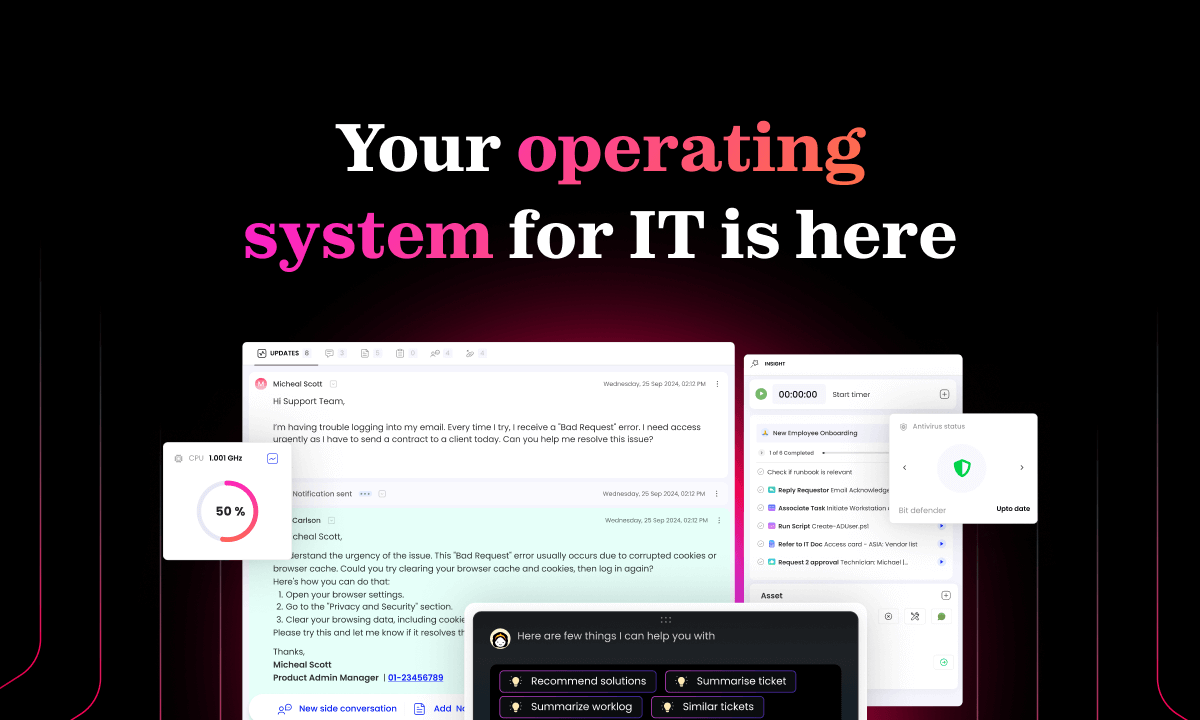
PSA and RMM platform for MSPs (MSPSuite) and in-house IT teams (ITSuite), with ticketing, endpoint management, patching and asset management.
TL;DR
- SherpaDesk: PSA only — tickets, time, expenses, quotes, invoices, projects, knowledge base. One agent free permanently; $40/agent/month on Base Camp, $50 on High Camp where asset management lives.
- SuperOps: PSA and RMM in one product, billed per endpoint. Prime from $1.50/endpoint/month with a 100-endpoint minimum; Prime Plus from $3.00 with a 150-endpoint minimum. 15% off annual.
- Ratings: 4.1 and 4.4. SuperOps is the better-built platform; SherpaDesk is the cheaper one by an order of magnitude at small scale.
Where each one starts costing money
The entry points could hardly be further apart.
SherpaDesk's first agent is free forever, with nothing stripped out — full ticketing, time tracking, invoicing, quoting, projects, reporting, knowledge base, mobile app. A solo IT consultant can run an entire business on it and never pay. The step to agent two is abrupt: $960 a year at the annual rate, with no intermediate plan.
SuperOps has a hard floor built from device minimums. Prime demands 100 endpoints, which is $150 a month whether you manage 100 devices or 40. Prime Plus demands 150, which is $450 a month at list. An MSP with 60 machines under contract pays an effective $2.50 per device because of the minimum. There is no version of SuperOps that costs nothing, and no version that costs less than $1,800 a year.
That difference means the two products are rarely evaluated by the same buyer at the same moment. They become comparable when a small consultancy starts taking on managed-endpoint contracts and has to decide whether to bolt an RMM onto SherpaDesk or move the whole operation.
Two meters, two opposite incentives
SherpaDesk bills per agent. Hire a technician, pay more. Take on 300 more devices, pay nothing extra — though SherpaDesk is not monitoring those devices in the first place, only inventorying them on High Camp.
SuperOps bills per endpoint with volume bands: $1.50 up to 100, then $1.40, $1.30 and $1.20 as you cross 500 and 1,000 devices. The spread is 20% and the bottom band requires 1,000 endpoints, so most small MSPs sit permanently at $1.40 to $1.50 and should budget there.
The consequence is that SuperOps rewards technician-heavy, device-light operations and penalizes lean automated ones — which is a little ironic given who the product markets to. Six technicians on 300 endpoints pay $420 a month, about $70 per head. Two technicians on 800 endpoints pay $1,040, about $520 per head. Run your own ratio before assuming a per-endpoint model is the cheap one.
One caveat on research: older comparison articles still quote SuperOps at roughly $89 per technician for PSA and $149 for PSA plus RMM. That model is superseded by the published per-endpoint pricing, and budgets built on the old figures will be badly wrong in one direction.
Monitoring is the capability gap
SuperOps does unified endpoint management across Windows, macOS and Linux, automated patching and compliance, network monitoring, scripting, and AI-filtered alerting meant to suppress false positives instead of paging technicians about them. Prime Plus adds Apple and Android MDM — that mobile capability is the entire difference between the tiers, so if your fleet is desktops and servers, Prime covers everything and Prime Plus is spend without deployment.
SherpaDesk has none of that. Its asset management is inventory and lifecycle tracking, useful for knowing what a client owns and when the warranty expires, not for pushing a patch at midnight. If monitoring matters to your service contracts, SherpaDesk is at best half your stack.
Where SherpaDesk still wins on merit
Billing structure, mostly. Time logged against tickets flows into invoices with QuickBooks, Xero and FreshBooks connections, and contractor licenses cost $10 per technician rather than a full seat — meaningful for a shop with a rotating subcontractor bench. SherpaDesk also serves K-12 district technology departments specifically, a segment most MSP platforms ignore entirely.
Its weaknesses are stated plainly in its own listing: a dated interface, and reporting that does not reach ConnectWise or Autotask depth. SuperOps, by contrast, is explicitly a modern-UI product, though a newer one with a thinner integration ecosystem and a real migration cost for anyone leaving a heavily customized legacy PSA.
Who should pick what
- Solo consultant or two-person services shop → SherpaDesk. Free, then $40–$50, against a $150/month floor you cannot avoid on SuperOps.
- MSP with 100+ managed endpoints → SuperOps Prime. Monitoring plus service desk from one vendor is the value case.
- MSP whose client contracts are priced per device → SuperOps, because software cost then tracks revenue in lockstep.
- Managing Apple or Android fleets under MDM → SuperOps Prime Plus, and model renewals at the $3.00 list rather than the $2.50 promotional rate.
- Under 100 devices → SherpaDesk plus a standalone RMM will almost always beat paying a 100-endpoint minimum.
- K-12 or internal IT billing time to departments → SherpaDesk High Camp.
Bottom line
This is a size-and-shape decision, not a features shootout. SherpaDesk is the correct choice while your business is hours-based or your device count is small, and its free tier makes evaluation risk-free. SuperOps is the correct choice once managed endpoints are the product you sell, at which point the bundled RMM and service desk justify a per-device bill that SherpaDesk simply has no equivalent for. Count your endpoints, count your technicians, and check both vendors' current published rates — SuperOps in particular has changed its pricing model recently enough that most third-party comparisons are stale.
Try them yourself
Need help moving to SherpaDesk or SuperOps?
Craftt, the CRM team behind weekcrm, plans and runs the migration: field mapping, deduplication, history and a cutover your team won't notice. You get a fixed quote within one business day.